Oil and Gas Compliance and Permit Renewals in Saudi Arabia and Qatar
What oil and gas contractors and suppliers in Saudi Arabia and Qatar keep current: Aramco and QatarEnergy vendor registrations, company licences, site passes, personnel safety certificates and equipment inspections.
Contractors and suppliers to the oil and gas sector in Saudi Arabia and Qatar have two sets of gatekeepers. Government authorities issue the company's registration, licences, environmental permits and workers' residence permits; the national energy companies, Saudi Aramco and QatarEnergy, decide who can bid, who can enter a site and which equipment can be used. A lapse on either side has the same result: crews turned away at the gate, invoices held, or a company dropped from a tender list.
This guide covers what has to be renewed, who checks it, and how service companies keep thousands of certificates in date.
Two sets of gatekeepers: government and operator
The layers below show why oil and gas contractors carry so many more dated items than an ordinary company.
Who a GCC oil and gas contractor answers to
Operator and client
Saudi Aramco, QatarEnergy and other operators
- Supplier registration and qualification
- Localisation (IKTVA, Tawteen) status
- Contract-specific HSE approvals
Government
Ministry of Commerce, MOCI, Ministry of Municipality, labour and immigration authorities
- Commercial registration
- Trade licence
- Work permits and residence permits
Environment and safety
NCEC, Civil Defense, Ministry of Environment and Climate Change
- Environmental permits
- Civil defence approvals
Site, crew and equipment
Operators and accredited third parties
- Site access passes
- Personnel safety certificates
- Equipment inspection certificates
Saudi Arabia: company and supplier registrations
The company base in the kingdom is the commercial registration with its annual confirmation, a MISA investment licence for foreign-owned firms, municipal licences for yards and offices, and Civil Defense certificates. Environmental permits for operations such as waste handling or workshops come from the National Center for Environmental Compliance (NCEC). These are covered in our Saudi Arabia business licence guide.
For sector work, supplier status matters as much as the licence:
- Saudi Aramco supplier registration. Suppliers and contractors must be registered and approved for the categories of goods or services they offer, and keep their supplier profile, financials and certifications current.
- IKTVA. Aramco's In-Kingdom Total Value Add programme measures local value creation, and suppliers' scores are refreshed periodically and taken into account in tenders.
- Other operators. SABIC, Ma'aden and the major petrochemical joint ventures run their own vendor registration and prequalification processes.
Expired supplier documents, such as an outdated ISO certificate or an unconfirmed CR, can hold up tender eligibility and payments.
Qatar: MOCI, municipality and QatarEnergy
In Qatar, companies hold a commercial registration from the Ministry of Commerce and Industry (MOCI), renewed periodically, and a commercial licence from the Ministry of Municipality for each premises. The company's establishment record with the Ministry of Interior must be kept current to process residence permits, and work permits are managed through the Ministry of Labour. Some service companies are licensed in the Qatar Financial Centre (QFC) instead, with its own annual licence renewal.
QatarEnergy maintains supplier registration and prequalification for its own operations and many affiliated companies, and its Tawteen localisation programme supports local suppliers. Access to industrial cities such as Ras Laffan and Mesaieed requires site passes for people and vehicles, each with its own expiry. Environmental permits for industrial activity come from the Ministry of Environment and Climate Change. Our Qatar business licence guide covers the company-level renewals in more detail.
Crew certificates that decide who can work
Personnel certificates generate the largest volume of dates in oil and gas. Operators check them at mobilisation and at site entry, and an expired card can stop an individual from boarding a crew bus or helicopter.
Common personnel certificates in GCC oil and gas
| Item | Issued by | Renewal cycle |
|---|---|---|
Offshore safety induction (such as OPITO BOSIET/FOET) Refresher before expiry | Approved training centre | Commonly 4 years |
H2S awareness Sour gas sites | Approved training provider | Set by client, often 1-2 years |
Well control (such as IWCF) Drilling and well services roles | Accredited body | Commonly 2 years |
Crane operator and rigger cards Operator approval may also apply | Third-party certifier | Per scheme |
Medical fitness certificate Offshore and remote work | Approved physician | Per client policy |
Iqama or Qatar residence permit Tied to work permit | Jawazat / Ministry of Interior | Up to annual or multi-year |
Clients often add their own requirements, such as site-specific inductions, permit-to-work authorisations and gas tester approvals, each with a validity period. For a contractor with several hundred field staff, that can mean thousands of dates. See employee certification tracking for how to structure them.
Equipment, inspection and insurance
Equipment that goes to site needs certificates that the client will inspect:
- Lifting equipment and accessories, with periodic thorough examination.
- Pressure equipment and pressure safety valves, tested and recertified at set intervals.
- Equipment for hazardous areas, with explosion-protection certification and inspection records.
- Calibrated gauges, gas detectors and test instruments.
- Vehicles with annual registration, insurance and client-specific inspection stickers.
Insurance completes the picture: contractors' liability, marine and equipment cover, and employer's liability, each matching contract requirements and renewal dates. Contracts and frame agreements with operators also expire and must be renewed or extended before work orders run out.
Planning ahead of mobilisation and shutdowns
The busiest moments for renewals are not licence anniversaries but mobilisations and planned shutdowns, when an operator suddenly needs dozens of certified people and inspected tools on site at once. Check the whole crew list and equipment register at least 90 days before a known turnaround, and book refresher courses then, because training centres in Dammam, Jubail and Doha fill up when several shutdowns coincide.
Between peaks, a monthly review works well: list every crew certificate, equipment certificate and passport-linked document expiring in the next three months, confirm a course or inspection date for each, and flag anyone who cannot be renewed in time so planners can replace them before the roster is sent to the client.
What happens when a certificate lapses
In this sector, operators enforce compliance faster than regulators. A crew member with an expired certificate is turned away at the gate, and the contractor may face standby costs or penalties under the contract. Equipment without a valid inspection certificate cannot be used on site. A supplier registration that is not kept current can remove the company from tender invitations. On the government side, expired residence permits lead to fines, and a suspended CR or expired licence blocks visas and government services.
How RenewalDesk helps oil and gas contractors
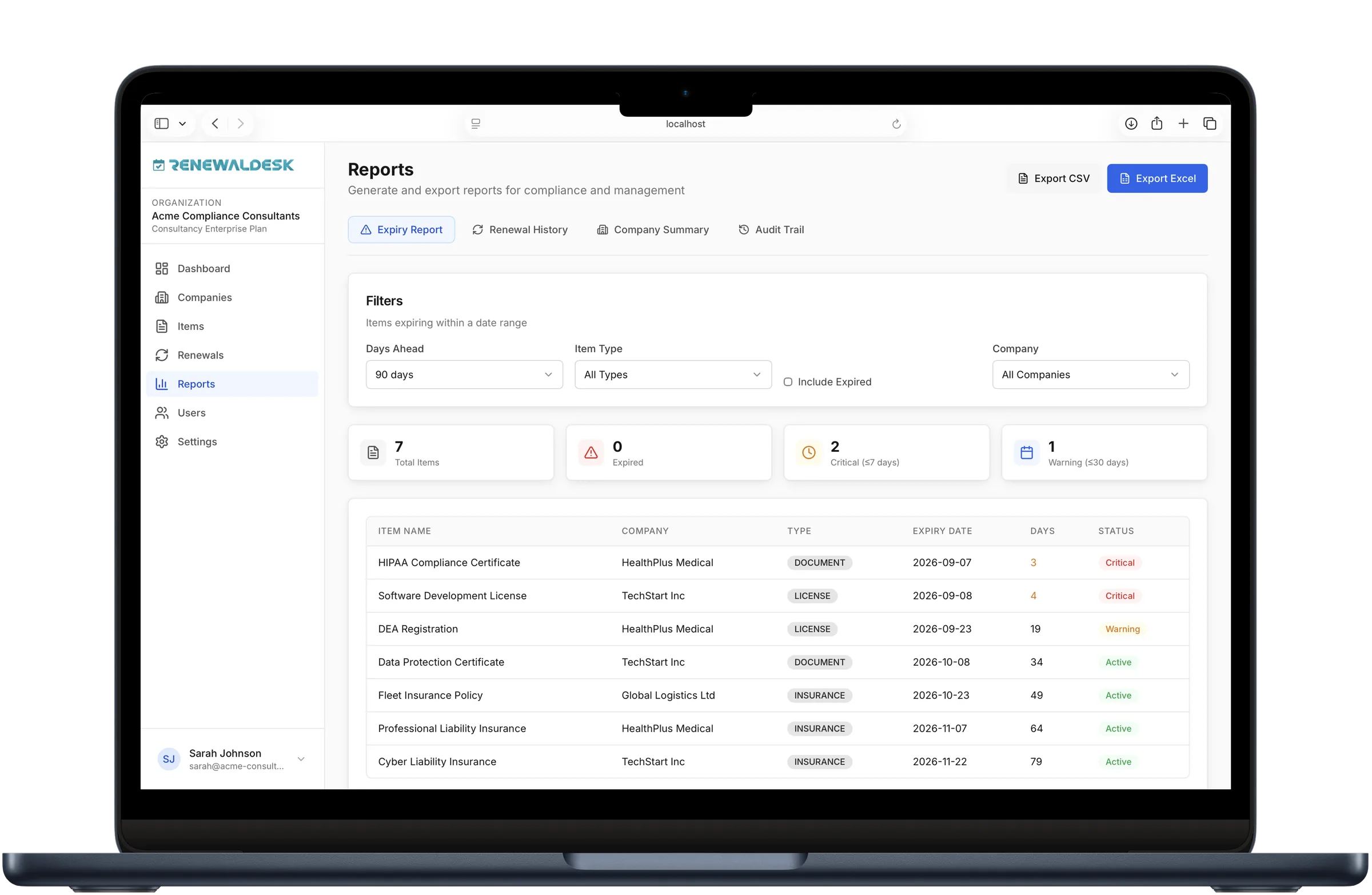
RenewalDesk puts company licences, supplier registrations, crew certificates, equipment certificates, insurance and contracts in one list, grouped by company, country or project. The dashboard shows what is expired or expiring first, so the operations team can see before mobilisation whether a crew is fully certified.
Reminders go by email and in the app at 90, 60, 30, 14, 7 and 1 days before expiry, with custom schedules for courses that need booking well in advance. Assign each renewal to HR, HSE or the contracts team, follow its checklist, attach the new certificate and record the new date. Reports and the audit trail export to Excel or CSV for client audits and prequalification submissions. Import existing training matrices from Excel to get started. See features, and for wider sector reading, renewal tracking for energy and utility companies. Companies using a government relations provider for visas can see RenewalDesk for PRO firms.
Frequently asked questions
How do I register as a Saudi Aramco supplier?
Suppliers register through Saudi Aramco's supplier registration process and are then qualified for specific categories of materials or services. Keep the supplier profile and supporting documents current, because outdated records can affect tender eligibility.
What is Tawteen in Qatar?
Tawteen is QatarEnergy's localisation programme for the energy sector, aimed at developing local suppliers and services. Suppliers registered with QatarEnergy may be assessed on their localisation contribution in tenders.
How long is a BOSIET certificate valid?
The OPITO BOSIET is commonly valid for four years, after which a FOET refresher is needed to stay current. Clients may set their own requirements, so check the contract before mobilising staff.
Do contractors in Qatar need a municipality licence as well as a CR?
Yes. Companies in Qatar generally hold a commercial registration from the Ministry of Commerce and Industry and a commercial licence from the Ministry of Municipality for their premises. Both have their own renewal dates.
Operator requirements and government rules change regularly. Confirm current requirements with Saudi Aramco, QatarEnergy and the relevant authorities before planning renewals around this guide.
Start tracking renewals today
Put every license, contract, and certificate in one place — and get reminded before anything expires.
Start free trialMore articles
- Manufacturing and Industrial Compliance Renewals in Saudi Arabia and Oman
What factories in Saudi Arabia and Oman keep current: industrial licences, MODON, RCJY and Madayn approvals, environmental permits, product conformity certificates, equipment inspections and workforce documents.
- Healthcare Licence and Compliance Renewals in Saudi Arabia
How Saudi hospitals, clinics and pharmacies keep SCFHS registrations, MOH facility licences, CBAHI accreditation, SFDA and NRRC licences, malpractice cover and staff iqamas current.
- Saudi Arabia Business Licence and Permit Renewals: A Tracking Guide
What companies in Saudi Arabia must keep current: CR annual confirmation, MISA licence, Balady and Civil Defense permits, iqamas and work permits, GOSI, and ZATCA filings.