California Healthcare License Renewals: Facilities, Clinicians, DEA and Labs
How California healthcare organizations keep facility licenses (CDPH), clinician licenses (Medical Board, BRN, Board of Pharmacy), DEA registrations, lab certificates and payer enrollments current.
California healthcare license renewals fall into two very different streams. The organization renews its facility license with the California Department of Public Health (CDPH), plus permits, lab certificates and payer enrollments. Every clinician renews a personal license with a separate board, such as the Medical Board of California or the Board of Registered Nursing, on a cycle tied to their own birth month or issue date. A hospital, clinic group or home health agency can have hundreds of these dates, and a single expired license means a provider who cannot see patients or bill for them.
The California healthcare renewal map
Who licenses what in California healthcare
Federal
DEA, CMS, HHS
- DEA controlled substance registrations
- CLIA laboratory certificates
- Medicare enrollment and revalidation
State: facilities
CDPH and DHCS
- Health facility licenses (hospitals, SNFs, clinics, home health)
- Clinical laboratory licenses or registrations
- Medi-Cal enrollment
State: professions
Boards under the Department of Consumer Affairs
- Physician licenses (Medical Board)
- RN licenses (BRN)
- Pharmacy permits and pharmacist licenses
- Other allied health licenses
County and city
Local agencies
- Business licenses
- Hazardous and medical waste permits
- Fire and occupancy permits
Facility licenses from CDPH
The CDPH Center for Health Care Quality, through its Licensing and Certification program, licenses general acute care hospitals, skilled nursing facilities, primary care and specialty clinics, home health agencies, hospices and several other facility types. Licenses are renewed annually with a license fee set by facility type and bed count. Facilities that take Medicare or Medi-Cal are also certified, and survey work is done by CDPH on behalf of CMS.
Not every facility type is a CDPH license. Residential care facilities for the elderly are licensed by the Department of Social Services, and certain behavioral health and substance use programs by the Department of Health Care Services. Check which department licenses each of your sites before building a renewal calendar, because the processes differ.
Facility licenses also have conditions that behave like renewals: changes of ownership, additions of services or beds, and relocations require approval before they happen, not afterward.
Clinician licenses: different boards, different cycles
Individual licenses are where large organizations spend most of their tracking effort.
- Physicians. The Medical Board of California renews physician licenses every two years, expiring at the end of the physician's birth month. Physicians must complete 50 hours of approved continuing medical education in each two-year cycle.
- Registered nurses. The Board of Registered Nursing renews RN licenses every two years, with 30 contact hours of continuing education per cycle. Nurse practitioners and other advanced practice nurses also hold separate certificates.
- Pharmacies and pharmacists. The California State Board of Pharmacy issues pharmacy permits, which renew annually, and pharmacist licenses, which renew every two years with continuing education.
- Other professions. Physician assistants, respiratory therapists, physical therapists, psychologists, licensed vocational nurses and many others renew with their own boards, each with its own CE rules.
Because each person's renewal month is personal, there is no single "renewal season". A medical group with 80 physicians has renewals in almost every month.
Common California healthcare renewals
| Item | Issued by | Renewal cycle |
|---|---|---|
Health facility license Fee by facility type and size | CDPH Licensing and Certification | Annual |
Physician license Ends in birth month; 50 hours CME | Medical Board of California | Every 2 years |
Registered nurse license 30 contact hours CE | Board of Registered Nursing | Every 2 years |
Pharmacy permit Separate from pharmacist licenses | California State Board of Pharmacy | Annual |
DEA registration Per state and practice location | DEA | Every 3 years |
CLIA certificate Plus a state lab license or registration | CMS | Every 2 years |
BLS / ACLS cards Often a condition of employment | Training provider | Every 2 years |
DEA, labs, radiation and other federal items
Several federal and specialty items sit alongside the state licenses:
- DEA registrations for practitioners who prescribe or dispense controlled substances run three years and are specific to the state and practice location. A California DEA registration also depends on a current California professional license. Practitioners renewing or applying now also attest to a one-time training requirement on substance use disorders.
- CLIA certificates for laboratory testing are issued by CMS and run two years. California additionally requires a state clinical laboratory license or registration, administered by CDPH Laboratory Field Services.
- Radiation equipment and staff. X-ray machines are registered with the CDPH Radiologic Health Branch, and radiologic technologists and supervisors hold state certificates or permits with their own CE.
- Payer enrollment. Medicare requires providers and suppliers to revalidate enrollment, generally every five years, and Medi-Cal has its own enrollment and revalidation process through the Department of Health Care Services.
Life sciences and pharmacy operations with manufacturing or wholesale activity should also see compliance renewals for pharmaceutical and life sciences companies.
How early to start each renewal
Different items need different lead times:
- Facility license and changes: start 90 days ahead, and longer for any change of ownership or new service, which needs CDPH approval first.
- Clinician licenses: 90 days, so there is time to finish CE. Most boards renew online quickly, but a CE audit or a disclosure question can add weeks.
- DEA: at least 60 days, because a lapsed registration cannot simply be backdated and prescribing must stop.
- Credentialing and privileging: hospitals re-credential medical staff on their own cycle, often every two years, and that process depends on current licenses, DEA and board certification.
What happens when a healthcare license lapses
- Unlicensed practice. A clinician who works on an expired license is practicing without a license, which is a board matter and can be a criminal one.
- Billing exposure. Claims for services by a provider whose license or enrollment had lapsed can be denied or recovered later, sometimes for the entire gap.
- Facility citations. CDPH can cite a facility for allowing unlicensed staff to work, and operating with an expired facility license is a separate violation.
- Controlled substances. Prescriptions written without a valid DEA registration are not lawful, and pharmacies will refuse them.
Organizing renewals for a multi-site provider
Clinic groups and health systems with several sites usually find that the hard part is ownership rather than dates. A workable split:
- Compliance or administration owns facility licenses, pharmacy permits, lab licenses, radiation registrations and local permits, grouped by site.
- The medical staff office or HR owns clinician licenses, DEA registrations, board certifications and life support cards, grouped by person.
- Revenue cycle owns Medicare and Medi-Cal enrollment and revalidation, because a lapse there shows up as denied claims.
Each group needs to see the others' items for the same site, because a new service line or location affects all three.
How RenewalDesk helps California health organizations
RenewalDesk keeps facility licenses, permits, lab certificates, payer enrollments and every staff license in one list, grouped by entity or site. The dashboard sorts it all by urgency.
- Reminders by email and in the app at 90, 60, 30, 14, 7 and 1 days by default, with longer custom schedules for items like facility changes or DEA.
- Renewal workflows assigned to the right person, such as the medical staff office for physician licenses or the lab director for CLIA, with a checklist and the new expiry date.
- Documents on each record, including the license printout or certificate, and an audit trail that exports to Excel or CSV for surveys and payer audits.
- Bulk import from an existing credentialing spreadsheet.
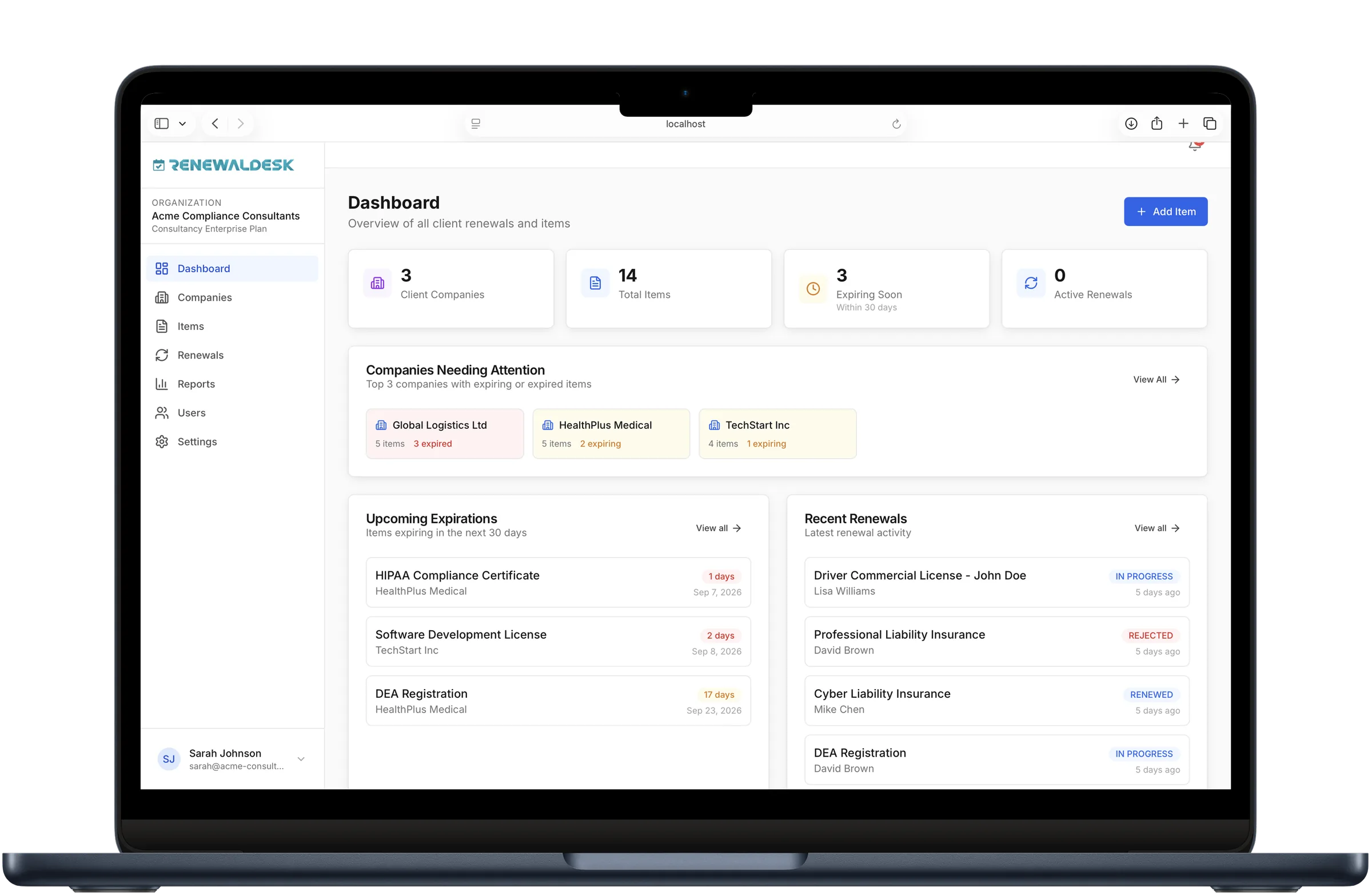
RenewalDesk tracks dates and evidence; it does not perform primary source verification or file with boards. For more on organizing staff credentials, see employee certification tracking software and renewal tracking for healthcare organizations. The California business license and permit renewal guide covers the general business filings. Plans are on our pricing page.
Frequently asked questions
How often do California physicians renew their license?
Every two years. Physician licenses issued by the Medical Board of California expire at the end of the physician's birth month, and 50 hours of approved continuing medical education are required in each two-year cycle.
How many CE hours do California RNs need?
Registered nurses renewing with the Board of Registered Nursing need 30 contact hours of continuing education every two years. Advanced practice certificates can carry additional requirements.
Who licenses clinics and hospitals in California?
Most health facilities, including hospitals, skilled nursing facilities and licensed clinics, are licensed by the California Department of Public Health through its Licensing and Certification program. Some facility types, such as residential care for the elderly, are licensed by other state departments.
How long is a DEA registration valid?
A DEA registration for a practitioner is generally valid for three years and is tied to a specific state and practice address. It also depends on the practitioner holding a current state license.
Board rules, CE hours and fees change. Confirm current requirements with CDPH, the relevant board or the DEA before renewing.
Start tracking renewals today
Put every license, contract, and certificate in one place — and get reminded before anything expires.
Start free trialMore articles
- California Food and Beverage License Renewals: Health Permits, CDPH, ABC and Staff Certifications
What California restaurants, food manufacturers and beverage producers renew each year: county health permits, CDPH processed food registration, ABC licenses and staff food safety cards.
- California Business License & Permit Renewal Guide: Statements of Information, City Tax Certificates and State Boards
The California renewals that catch businesses out: Statements of Information, the $800 minimum franchise tax, city business tax certificates, CSLB, DRE, ABC and air district permits.
- Healthcare Licence Renewals in the UAE: DHA, DoH and MOHAP
How UAE clinics and hospitals keep practitioner and facility licences valid with DHA, DoH and MOHAP: CME, malpractice cover, BLS, facility approvals, radiation licences and staff visas.