Healthcare Licence Renewals in the UAE: DHA, DoH and MOHAP
How UAE clinics and hospitals keep practitioner and facility licences valid with DHA, DoH and MOHAP: CME, malpractice cover, BLS, facility approvals, radiation licences and staff visas.
Healthcare providers in the UAE renew licences at two levels. Each doctor, nurse, pharmacist and allied health professional holds a personal licence from the health authority of the emirate where they practise, and each clinic, pharmacy or hospital holds a facility licence from the same authority. A practitioner whose licence has expired must stop seeing patients, and a clinic that loses one key licence may lose the right to operate a service, so the dates need watching per person and per site.
This guide explains which authority licenses whom, what a renewal normally needs, and how medical groups keep dozens of expiry dates under control.
DHA, DoH or MOHAP: which authority licenses you?
Health licensing in the UAE is split by emirate:
- Dubai Health Authority (DHA) licenses practitioners and private facilities in Dubai, through its Sheryan licensing system. Dubai Healthcare City has its own regulator, the Dubai Healthcare City Authority, for facilities in that free zone.
- Department of Health Abu Dhabi (DoH) licenses practitioners and facilities across Abu Dhabi, Al Ain and Al Dhafra.
- Ministry of Health and Prevention (MOHAP) licenses practitioners and private facilities in the northern emirates.
A licence from one authority does not let you practise in another emirate. A physician who works in a Dubai clinic and also consults in Abu Dhabi needs both a DHA and a DoH licence, each with its own renewal date. Groups operating across emirates therefore carry parallel sets of licences for the same people.
What a practitioner licence renewal needs
Requirements vary by authority and profession, but most renewals rest on the same set of documents:
- Continuing medical education (CME). Each authority sets the hours needed for the licensing cycle, and the activities must come from accredited providers. Log hours through the year rather than in the last month.
- Medical malpractice insurance. UAE law requires practitioners to be covered, so the policy must be valid for the renewal to go through and while the person practises.
- Basic Life Support (BLS) or other resuscitation certificates, which commonly expire after two years and are required for clinical staff.
- A valid residence visa and Emirates ID, sponsored by the facility or group.
- The employing facility's licence, since practitioner licences are usually linked to an active facility.
The authority can also require a good standing certificate or updated credentials when a practitioner's scope or grade changes. New practitioners go through primary source verification before their first licence, which can take weeks, so build that into hiring plans.
Working back from a practitioner's licence expiry
DHA, DoH or MOHAP professional licence
- 1
Throughout the cycle
Record CME activities as they are completed, with certificates attached.
- 2
90 days before
Check CME totals, BLS expiry and the malpractice policy end date.
- 3
60 days before
Book any missing CME or BLS course and renew the malpractice policy if it ends first.
- 4
30 days before
Submit the renewal through the authority's licensing system and pay the fee.
- 5
Licence expiry
The practitioner cannot see patients unless the renewed licence is active.
Facility licences and the approvals behind them
Clinics, pharmacies, laboratories, diagnostic centres and hospitals hold a facility licence from DHA, DoH or MOHAP, commonly renewed each year. The facility also holds a trade licence from the economic or free zone authority, and the two must agree on activities and address.
Around the facility licence sits a group of approvals that each carry their own dates:
| Item | Issued by | Typical cycle | Why it matters |
|---|---|---|---|
| Facility licence | DHA, DoH or MOHAP | Commonly annual | Required to operate any service |
| Trade licence and Ejari or Tawtheeq | Economic authority and tenancy registry | Usually annual | Facility licence depends on it |
| Radiation licence for X-ray or CT | Federal Authority for Nuclear Regulation (FANR) | Per licence term | Imaging must stop without it |
| Civil defence certificate | Emirate civil defence | Commonly annual | Premises safety |
| Medical waste contract | Licensed waste contractor | Per contract | Inspectors check it |
| Accreditation, such as JCI | Accrediting body | Multi-year cycle | Often required by insurers |
Pharmacies add controlled-medicine permits and pharmacist-in-charge requirements. Facilities with a cafeteria or kitchen need a municipality food permit. Insurer network agreements also renew on contract dates, and a lapsed agreement can mean claims are refused.
What happens if a healthcare licence lapses
A practitioner whose licence has expired cannot legally practise, and work done in the gap can create disciplinary exposure for the individual and the facility. Health insurers may refuse claims for treatment given by an unlicensed practitioner. For facilities, authorities can suspend services or close premises that operate without a valid licence, and late renewals incur fines.
Visa and licence dates also interact. If a practitioner's visa is cancelled or expires, their link to the facility breaks, and the licence may need to be transferred or reactivated before they can work again.
How medical groups keep renewals on schedule
The workload is driven by headcount. A polyclinic with 25 practitioners can easily carry more than 100 dated documents for its clinical staff alone: licences, BLS cards, malpractice policies, visas and Emirates IDs. Add the facility licence, FANR licence, civil defence certificate, waste contract and insurer agreements, and a single spreadsheet becomes a weekly chore that only one person understands.
A workable routine is a monthly review of everything expiring in the next 90 days, a named owner for each practitioner's renewal (often the medical director's office for licences and HR for visas), and a rule that no one is rostered past their licence expiry until the renewed licence is active.
Tracking DHA, DoH and MOHAP renewals in RenewalDesk
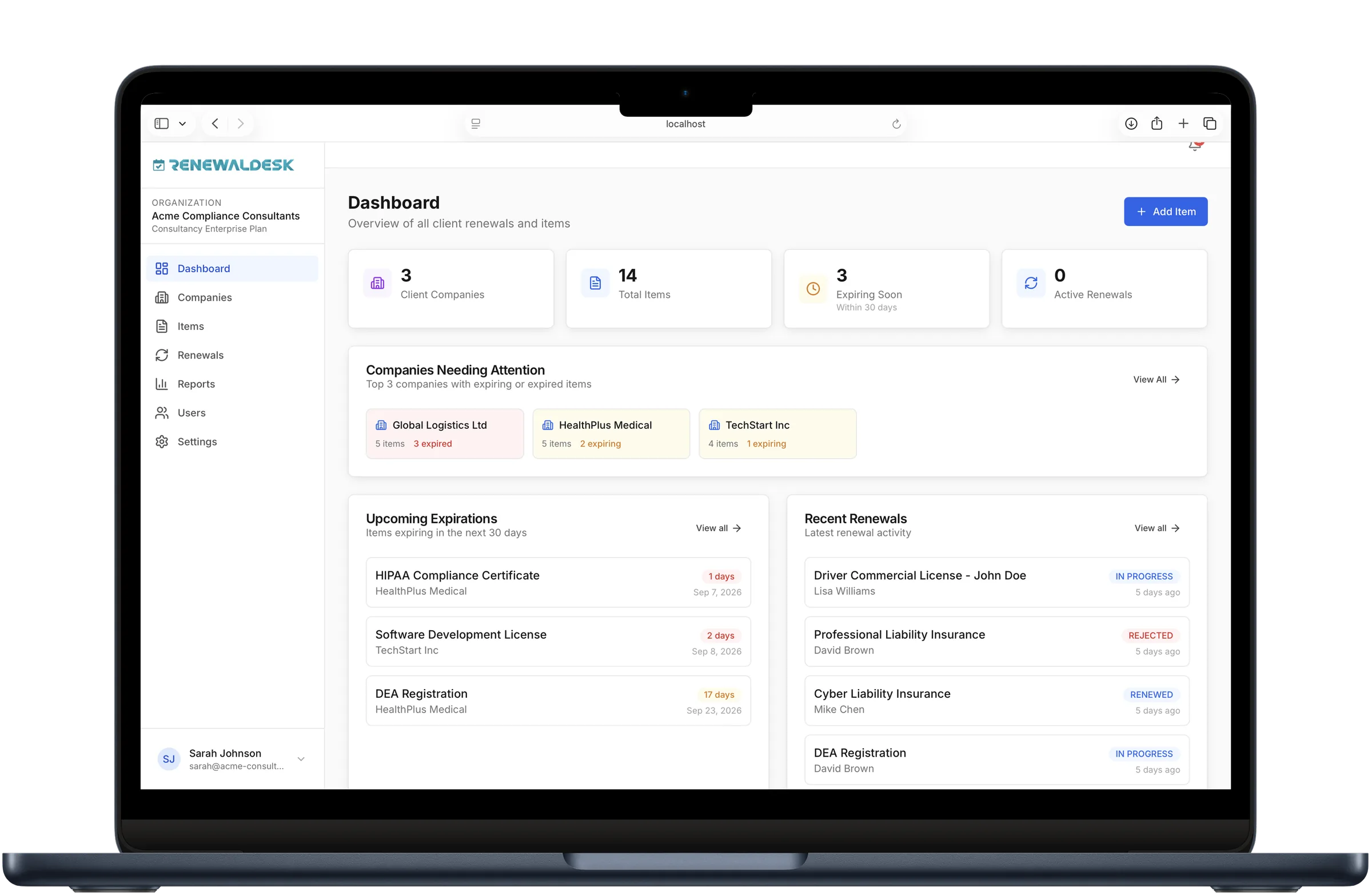
RenewalDesk keeps practitioner and facility items on one list, grouped by facility or entity. Add each clinician's licence, BLS certificate, malpractice policy, visa and Emirates ID as separate items, attach the current documents, and the dashboard shows what is expired or expiring first across every site.
Reminders go by email and in the app at 90, 60, 30, 14, 7 and 1 days before each expiry; you can lengthen the schedule for items that need CME or course bookings. When a renewal starts, assign it, follow a checklist such as "CME confirmed, malpractice renewed, application submitted", then attach the new licence and enter the new expiry. The audit trail records who changed what, which helps during authority inspections and accreditation surveys. Import your existing staff list from Excel to get started, and see features or pricing for details.
For more on clinical staff credentials, read employee certification tracking and renewal tracking for healthcare organisations. Groups expanding into the kingdom should see our guide to healthcare licence renewals in Saudi Arabia. If a PRO firm handles your visas, our PRO services page shows how they can manage your dates alongside you.
Frequently asked questions
Can I practise in Abu Dhabi with a DHA licence?
No. A DHA licence covers practice in Dubai only. To work in Abu Dhabi you need a DoH licence, and for the northern emirates a MOHAP licence. Practitioners working in more than one emirate hold separate licences with separate renewal dates.
How many CME hours do I need to renew a UAE medical licence?
Each authority sets its own CME requirement, which can differ by profession and licence type. Check the current requirement in DHA, DoH or MOHAP guidance for your category, and keep certificates from accredited providers so they can be verified at renewal.
Is malpractice insurance mandatory for doctors in the UAE?
Yes. UAE medical liability law requires practitioners to hold malpractice insurance, and health authorities check for a valid policy at licensing and renewal. Track the policy end date separately from the licence, because the two rarely fall on the same day.
Does a clinic's X-ray machine need its own licence?
Yes. Facilities using X-ray, CT or other radiation sources need a licence from the Federal Authority for Nuclear Regulation (FANR), and staff working with radiation may need their own permits. These run on their own dates, separate from the health facility licence.
Health authorities update licensing standards often. Check the current requirements with DHA, DoH or MOHAP before you plan a renewal around anything described here.
Start tracking renewals today
Put every license, contract, and certificate in one place — and get reminded before anything expires.
Start free trialMore articles
- Education and Training Licensing in the UAE: A Compliance Guide
What UAE schools, nurseries and training institutes renew each year: KHDA, ADEK, SPEA and MOE permits, trade licences, teacher credentials, clinics, buses and staff visas.
- Technology and Telecom Licensing in the UAE: A Compliance Guide
What UAE tech, telecom and media companies keep renewed: free zone or DET licences, TDRA type approvals and dealer registrations, data protection obligations, certifications and the technical assets that expire.
- Real Estate Licensing and Compliance Renewals in the UAE and GCC
What brokerages and property managers in Dubai, Abu Dhabi and the GCC keep renewed: RERA broker cards, office registration, Trakheesi permits, Ejari, AML registration and agents' visas.