Pharmaceutical Licence Renewals in the GCC: Products, Establishments, GMP and Pharmacists
What pharma manufacturers, importers, distributors and pharmacies renew across the GCC: marketing authorisations, establishment licences, GMP certificates and professional licences.
Pharmaceutical and medical device companies in the Gulf renew at four levels: the product (marketing authorisation or registration), the establishment (factory, warehouse, scientific office or pharmacy licence), the manufacturing site (GMP certificates, often from overseas plants), and the people (pharmacist licences and named responsible persons). Each GCC country runs its own registrations, and a lapse at any level can stop a product from being imported, sold or dispensed.
This guide maps pharmaceutical licence renewals across the GCC and shows how to keep a portfolio of products and sites in view.
Who regulates medicines and devices in each GCC country?
Pharmaceutical regulators in the GCC
| Item | Issued by | Renewal cycle |
|---|---|---|
Saudi medicines, devices and establishments | Saudi Food and Drug Authority (SFDA) | Time-limited registrations and licences |
UAE federal product registration | MOHAP / Emirates Drug Establishment | Time-limited registrations |
Pharmacies and pharmacists in Dubai and Abu Dhabi | DHA (Dubai), DoH (Abu Dhabi) | Per facility and professional licence |
Qatar medicines and pharmacies | Ministry of Public Health | Per registration and licence |
Bahrain medicines and pharmacies | National Health Regulatory Authority (NHRA) | Per registration and licence |
Kuwait and Oman | Ministry of Health in each country | Per registration and licence |
In the UAE, federal medicines regulation has been moving from the Ministry of Health and Prevention (MOHAP) to the Emirates Drug Establishment, created to take over that role. Check which body handles your product category before you file. Across the region, the Gulf Health Council also runs a centralised GCC registration route that some companies use alongside national registrations.
Product registrations and marketing authorisations
Every medicine sold in a GCC country needs a registration in that country, and the registration is not permanent. Expect:
- Renewal on a fixed multi-year cycle, with the dossier, prices and labelling confirmed at each renewal.
- Variations for changes to the manufacturing site, formulation, pack or labelling, which must be approved before the change is implemented.
- Pricing approvals that some regulators review separately from the registration.
- Medical device registrations, such as SFDA's Medical Device Marketing Authorization (MDMA), which often depend on the device's CE or FDA status staying valid.
A company with 200 products registered in three countries is managing 600 registration dates, before variations. That is the main reason pharma regulatory teams outgrow spreadsheets.
Establishment licences: factories, warehouses, scientific offices and pharmacies
The premises that make, store and sell medicines are licensed separately from the products:
- Manufacturing licences for local factories, issued by SFDA in Saudi Arabia and by the federal regulator in the UAE, with GMP inspections as a condition.
- Drug store and warehouse licences, which require Good Distribution and Storage Practice, temperature mapping and calibrated monitoring.
- Scientific office or marketing authorisation holder registrations for foreign manufacturers' local representatives.
- Pharmacy licences from DHA, DoH, SFDA or the relevant ministry, renewed alongside the commercial licence.
- Controlled and narcotic drug permits, which have their own records and inspection regime.
GMP certificates and overseas sites
Most medicines sold in the Gulf are made elsewhere, so GCC regulators rely on evidence that the overseas plant meets GMP. That creates dates you do not control:
- GMP certificates issued by the plant's home regulator or by a GCC inspection, each with an expiry date.
- Certificates of Pharmaceutical Product (CPP) and free sale certificates, needed for registration and renewal, which must be current and often legalised.
- Third-party contract manufacturers whose GMP status underpins your registration.
If a supplying site's GMP certificate lapses, the products made there can face suspension until new evidence is accepted. Track each manufacturing site as its own item, linked to the products it supplies.
What a single medicine depends on in the GCC
Product
SFDA, UAE federal regulator, national ministries
- Registration in each country
- Approved variations
- Price approval
Site
Home regulator or GCC inspection
- GMP certificate
- CPP or free sale certificate
Establishment
Medicines regulator, municipality
- Warehouse or drug store licence
- Commercial licence
People
SCFHS, DHA, DoH and others
- Pharmacist licences
- Responsible person and pharmacovigilance officer
Pharmacists, responsible persons and pharmacovigilance
Licensing bodies expect named, licensed people in key roles:
- Pharmacist licences from the Saudi Commission for Health Specialties (SCFHS), DHA, DoH, NHRA or the relevant ministry, renewed periodically with continuing education credits.
- Responsible pharmacists for each pharmacy, warehouse or factory. If that person leaves, the establishment licence may need updating.
- Qualified person for pharmacovigilance for marketing authorisation holders, with safety reports (PSURs) due on a schedule.
- Good Distribution Practice and cold chain training for warehouse staff, refreshed periodically.
Planning lead times for pharma renewals
Pharmaceutical renewals take longer than commercial ones because the paperwork often starts outside the Gulf. A workable plan:
- 12 months ahead of a product registration expiry: check whether the dossier needs updating and whether any variations are pending.
- 6 to 9 months ahead: request a current CPP, GMP evidence and any legalised documents from the manufacturer. Embassy legalisation and translation can take weeks on their own.
- 3 to 6 months ahead: submit the renewal, following the regulator's published submission window for your product type.
- 90 days ahead of an establishment licence: confirm the responsible pharmacist's licence, warehouse temperature mapping and calibration certificates are current.
Regulators publish their own submission windows, and some will not accept a renewal too early or too late. Use their guidance, then build your internal deadlines in front of it.
What happens when something lapses
Consequences depend on the item. An expired product registration means the product cannot legally be imported or sold until it is renewed or re-registered. An expired establishment licence can close the warehouse or pharmacy. A pharmacist working on an expired licence exposes both the person and the employer to penalties. Health regulators in the region inspect regularly and take licensing seriously, so a margin of several months on product and GMP renewals is normal practice.
How RenewalDesk supports pharma regulatory teams
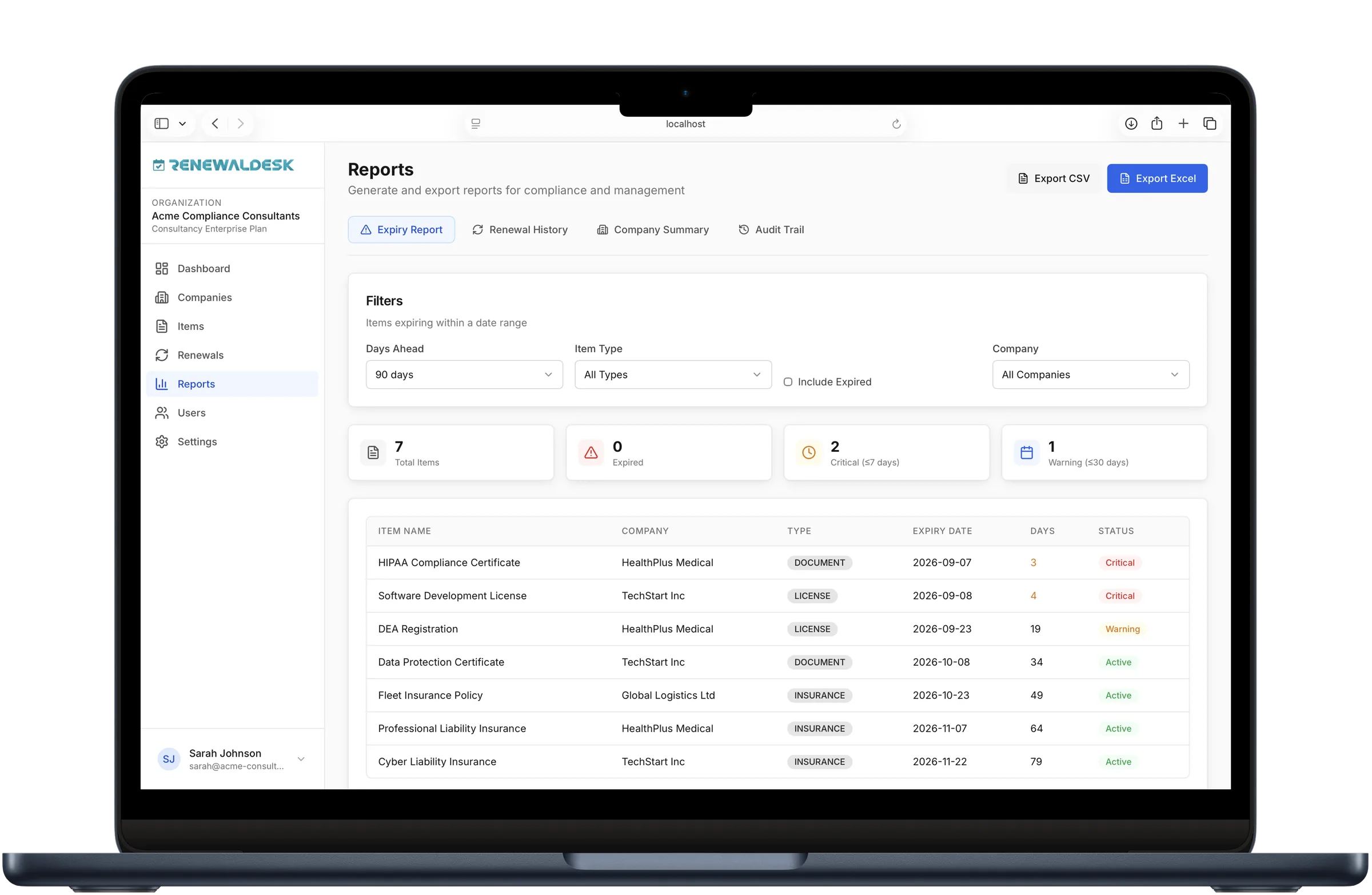
RenewalDesk is a renewal tracker, not a regulatory information management system. It does not hold dossiers or submit to SFDA or any other regulator. What it does well is make sure no date in the portfolio is missed:
- Every registration, licence and certificate in one list, grouped by legal entity or country, with the current certificate attached.
- Early reminders by email and in-app. The default schedule is 90, 60, 30, 14, 7 and 1 days before expiry; set a custom schedule starting much earlier for product renewals and GMP certificates.
- Renewal workflow. Assign each renewal to a regulatory officer, track steps such as legalising a CPP or updating the dossier, and record the new expiry date when approved.
- Audit trail and exports of every change, useful for internal audit and inspections.
- Bulk import of an existing registration register from Excel or CSV.
For the global picture, see compliance renewals for pharmaceutical and life sciences companies. Pharmacy groups and hospitals should also read healthcare licence renewals in Saudi Arabia and healthcare licensing in the UAE. All features are listed on the features page.
Frequently asked questions
Who registers medicines in Saudi Arabia?
The Saudi Food and Drug Authority (SFDA) registers medicines and medical devices and licenses pharmaceutical factories, warehouses and other establishments. Registrations are time-limited and must be renewed, with the dossier and labelling kept current.
Who regulates pharmaceuticals in the UAE?
Federal product registration has been handled by the Ministry of Health and Prevention (MOHAP) and is moving to the Emirates Drug Establishment. Pharmacies and pharmacists are licensed by the emirate health authority, such as the DHA in Dubai and the DoH in Abu Dhabi, or by MOHAP in the other emirates.
Do GMP certificates expire?
Yes. GMP certificates are issued for a limited period after an inspection, and GCC regulators expect current GMP evidence for each manufacturing site supplying registered products. Track each site's certificate and request renewed evidence before it expires.
Is there a single GCC registration for medicines?
The Gulf Health Council operates a centralised registration route for GCC member states, but national registration and marketing requirements still apply. Many companies track both the centralised and the national registrations.
Pharmaceutical regulation in the GCC is evolving, including changes to regulators and procedures. Confirm current requirements with the relevant authority before you renew.
Start tracking renewals today
Put every license, contract, and certificate in one place — and get reminded before anything expires.
Start free trialMore articles
- Compliance Renewals for Pharmaceutical and Life Sciences Companies
Establishment registrations, controlled-substance licenses, GMP certificates, clinical trial obligations and supplier qualifications: what a pharma or biotech company must keep current, and how to track it.
- Environmental Permit Renewals in the GCC: Regulators, Permits and Monitoring Deadlines
Which environmental permits GCC operators renew, who issues them in each country, and how to keep monitoring reports, waste permits and ISO 14001 audits from slipping.
- Insurance Licence Renewals in the GCC: Insurers, Brokers and the Policies Every Business Must Keep
Who licenses insurers and brokers in each GCC country, the recurring obligations behind those licences, and the mandatory policies other businesses must keep renewed.